


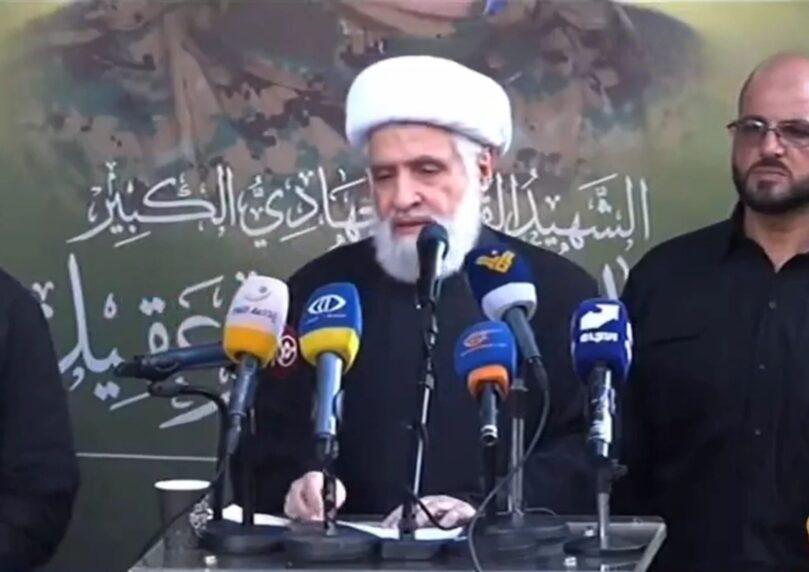

While in hiding, Hezbollah’s top terrorist Naim Qassem delivered a speech Wednesday night marking the start of Ashura—commemorating Imam Hussein, the spiritual father of Shiite Islam—at the burial site of the mass murderer Hassan Nasrallah. The address, broadcast on giant screens while Qassem himself hid in an undisclosed location, blended Shiite religious messaging with sharp attacks on Israel and the United States. Qassem emphasized the organization’s commitment to the path of terror.


 5+
The Imam’s Path
Qassem opened with traditional Ashura blessings and highlighted this year’s slogan: “Hussein is our path.” He explained that Imam Hussein’s path is clear, straight, and full of sacrifice: the path of reform in the nation carried out by his grandfather the Prophet Muhammad, the struggle against tyranny, commanding good and forbidding evil, and self-sacrifice for truth. He recalled the “Battle of Karbala” as a unique event in human history, when Hussein fought the forces of the Umayyad Caliph Yazid I.
Hussein, who refused to pledge allegiance to Yazid, set out with his family and supporters to Karbala in modern-day Iraq. There he and 70 of his men were surrounded by a much larger military force, in a battle that ended in the massacre of Hussein and his family. After their deaths, they were considered to have sacrificed their lives for eternal values. Qassem linked this directly to the current struggle of “the resistance,” emphasizing that the commemoration is not merely cultural or emotional, but also practical and jihadist.
 5+
Blessing the “Great Victory” in Iran
A large portion of Qassem’s speech was devoted to praising the Iranian regime. Qassem blessed what he called Iran’s “great victory” against American attempts to topple the ayatollahs’ rule. According to him, “the pride of American tyranny has been broken,” and Washington’s colonial project toward Iran did not achieve its goals.
Qassem also emphasized the heavy price Iran paid, led by Supreme Leader Ali Khamenei, alongside commanders, soldiers, and other senior officials in the Revolutionary Guards and Iranian army. According to him, Iran emerged stronger and became an influential regional power that is changing the balance of power in favor of the region’s peoples.
 5+
Hezbollah as ‘Lebanon’s Shield’
Qassem described the situation in Lebanon as an “existential struggle.” According to him, Israel has sought since 1948 a “weak Lebanon” in order to conquer and swallow it, as part of the “Greater Israel” project declared by Prime Minister Benjamin Netanyahu. The goal, he claimed, is to eliminate Hezbollah militarily, culturally, politically, and socially. In other words, “annihilation” of a broad segment of the Lebanese people through killing, displacement, and transfer to other areas.
The resistance, by contrast, defended Lebanon’s “existence, life, and future.” According to him, Hezbollah thwarted the “Greater Israel” project in Lebanon through the steadfast stand of the people and fighters, while paying a heavy price.
 5+
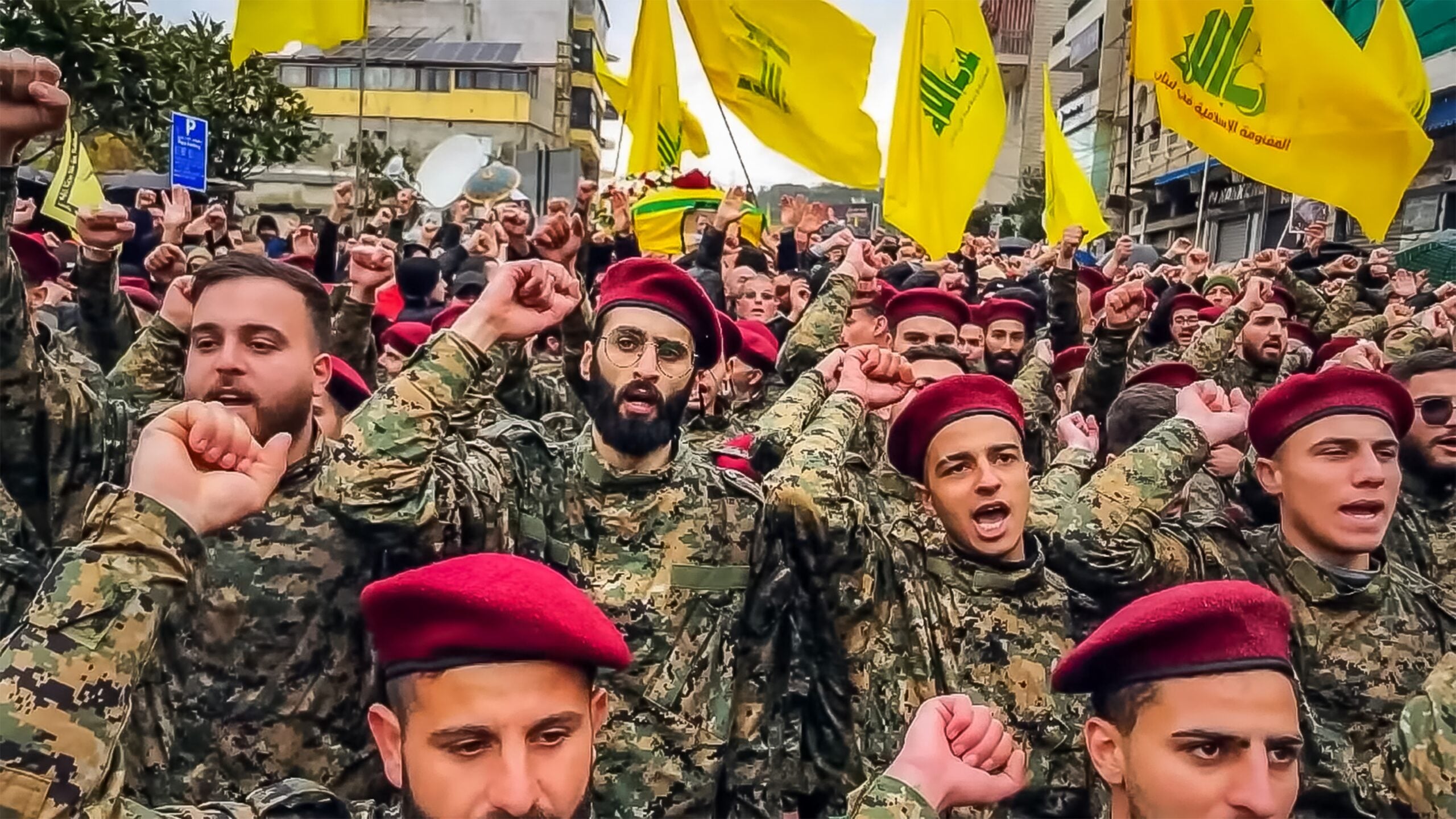
Another section of the speech was devoted to detailed statistics about Hezbollah fighters’ achievements, which he called “legendary.” According to Qassem, over 105 days Hezbollah forces conducted 3,185 combat operations (averaging about 30 operations per day), hit 518 IDF military vehicles and about 85 aircraft (including downing 12 drones and 12 quadcopters, and hitting a helicopter). He claimed 1,347 wounded in Israeli army ranks.
“No Yellow or Red Zones”
Regarding a political settlement, Qassem hardened his positions and demanded an absolute ceasefire. Beyond that, he made clear that “any attempt to disarm Hezbollah will not pass,” and that “what was not achieved in war cannot be imposed through negotiations.”
 5+
He further emphasized that Israel must withdraw from all Lebanese territories, with no room for “yellow or red zones” or safe/experimental areas. In this context, Qassem demanded the return of displaced persons and the reconstruction of southern Lebanon, while making clear that the resistance “cannot be uprooted” and its destiny is “the promised victory.”
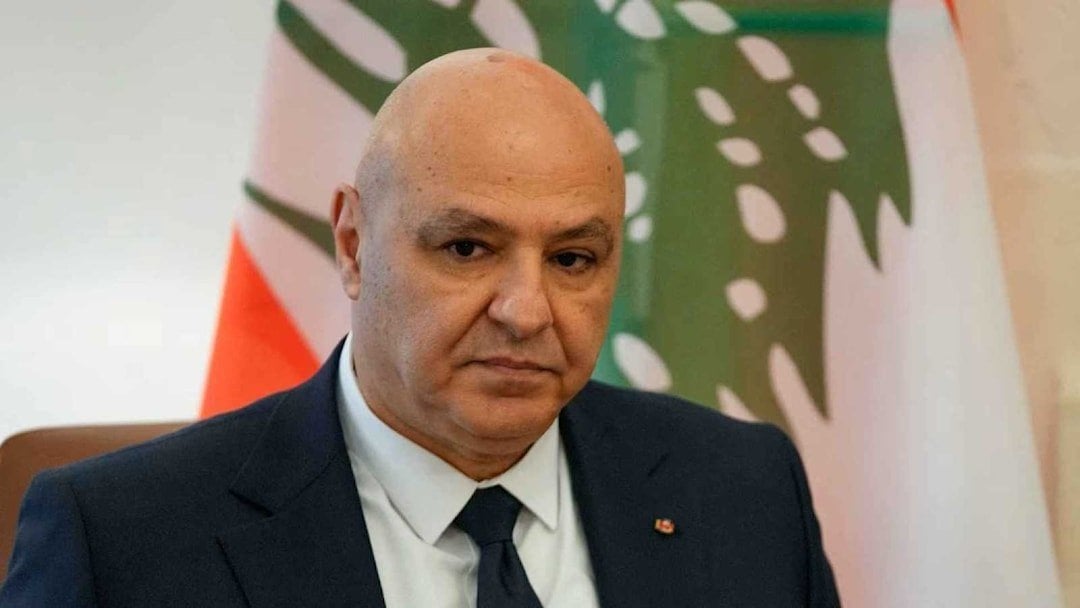
At the end of the speech, he called on the Lebanese government not to negotiate with Israel on Lebanon’s internal affairs and even to consider conducting indirect rather than direct negotiations. “We call on President Joseph Aoun and the political authority to take responsibility for uniting our ranks through dialogue, calm discussion, and agreement. We are ready to cooperate, and we proved this by facilitating the deployment of the Lebanese army in the south.”
 5+
The Goal: Preserving ‘Legitimacy’
Naim Qassem’s speech reflects Hezbollah’s desperate attempt to preserve internal and religious legitimacy in Lebanon under fire. The combination of religious-historical inspiration from Ashura and Imam Hussein’s path (sacrifice, reform, and struggle against tyranny) with hardline political demands shows an intention to continue fighting at any cost. Qassem is trying to leverage Iran’s “victory” to strengthen his operatives’ morale, while setting red lines that would prevent any possibility of a realistic security arrangement on the northern border.