


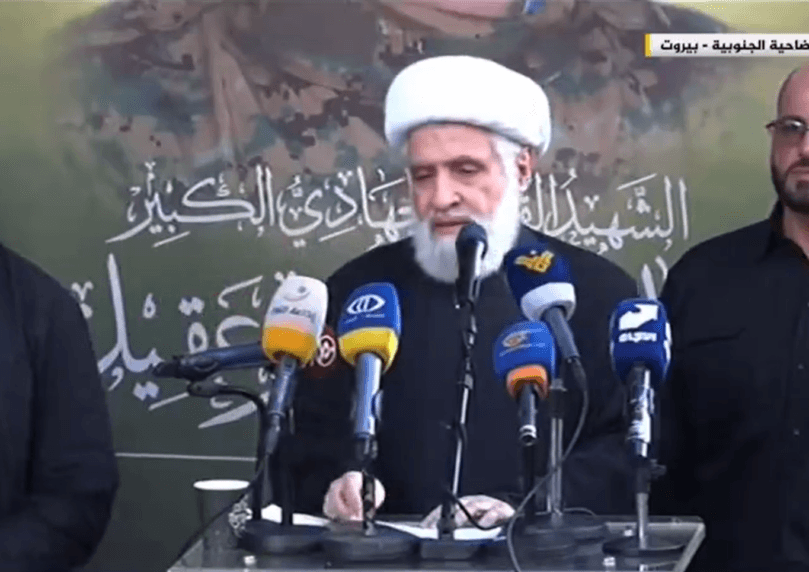

The arch-terrorist, also known as Hezbollah’s “Secretary-General,” Naim Qassem spoke Wednesday evening, delivering the Lebanese terror group’s consistent message since the conflict escalated. In a speech emphasizing the organization’s resilience against Israeli pressure, Qassem framed the ceasefire as a political and military “victory”—crediting Iran as the decisive force that compelled Israel to stop fighting.
Qassem sought to portray the Iranian axis’s systemic triumph, presenting the current agreement not as a concession but as a strategic achievement: “We thank Iran for linking the Lebanese arena to the resistance and forcing Israel to stop its aggression. The goal was to topple the Iranian regime, and Washington’s colonial project against Iran has shattered and failed.”
According to Qassem, the organization wasn’t just unharmed—it emerged stronger: “Israel failed to kill us and failed to conquer our land. Hezbollah didn’t just fight for the land, but also defends Lebanon’s existence and future.”
In a move designed to demonstrate his commitment to the current arrangement in Lebanon, Qassem delivered a conciliatory message to the Lebanese political establishment: “We call on President Joseph Aoun and the political authority to take responsibility for uniting our ranks through dialogue, calm discussion, and agreement. We are ready to cooperate, and we’ve proven this by facilitating the deployment of the Lebanese army in the south.”
Qassem’s remarks present the current agreement as a double victory: successful deterrence against Israel on one hand, and consolidation of the Iranian-led “axis of resistance” influence against American pressure on the other. By framing the Lebanese army’s southern deployment as the organization’s initiative, Qassem attempts to turn a security obstacle into a political asset—ensuring Hezbollah’s legitimacy as “Lebanon’s protector” even after the fighting ends.