


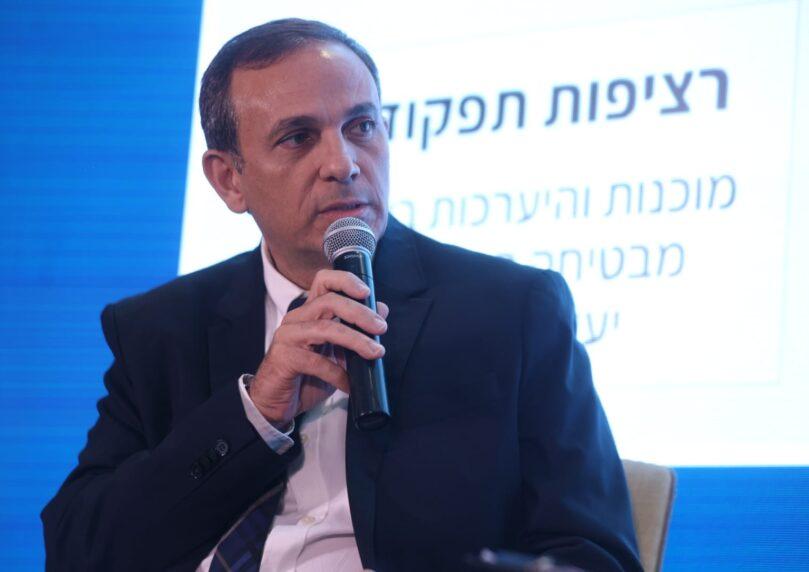

Energy and Infrastructure Ministry Director General Yossi Dayan told the Israeli Institute for Energy and Environment’s “Energy Summit 2026” today (Tuesday) that fortifying Israel’s national energy infrastructure is critical to giving the IDF operational freedom to strike Iranian targets.
Dayan said the recent war demonstrated the need for early preparation and significant investment in the sector, arguing that Israel’s energy resilience directly affects its ability to make security decisions and operate during emergencies.

He said one of the main considerations in evaluating strikes on enemy energy targets is Israel’s ability to withstand a counterattack. The more protected and resilient Israel’s energy sector, he said, the more room decision-makers have on security matters—including strikes on Iran’s energy infrastructure.
“The public saw that there was electricity, water and fuel, but behind that stood enormous work done throughout the war,” Dayan explained. “One of the considerations in evaluating a strike on energy facilities in enemy countries is what the response against Israel will be. If we want decision-makers to have more freedom of action on security matters—we need to be much more protected. At the end of the day, this is about national risk management.”
Dayan said the energy sector developed dedicated solutions for extreme scenarios in electricity, gas, fuel and water, and the fear of widespread blackouts never materialized thanks to early preparation. He stressed that Israel cannot rely on a single energy source and called for advancing civilian nuclear energy in Israel.

“In my opinion, nuclear energy is the most efficient and safe energy. There are political, security and regulatory difficulties, but if my opinion were heard—this should be Israel’s next energy,” he said.
Dayan also addressed the development of artificial intelligence and called on Israel to develop independent AI capabilities to reduce dependence on foreign entities. He also addressed one of the main bottlenecks in developing the electricity sector—the transmission grid—and estimated that by 2028 it will no longer be a significant bottleneck.