


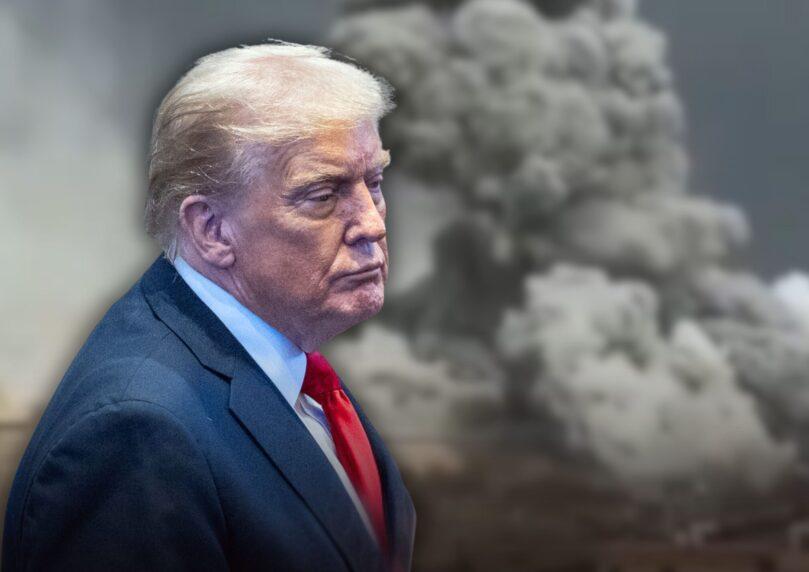

U.S. Central Command announced Wednesday morning the completion of a major three-wave strike operation against military targets inside Iran that began Tuesday night. The operation, which Washington described as a “proportional self-defense action,” was ordered directly by President Donald Trump following the downing of an American attack helicopter late Monday night. The entire region entered active war footing as Tehran threatened that its armed forces would respond forcefully to every strike and begged American forces to evacuate from the Middle East.
During the concentrated military operation, Air Force and Navy fighter jets fired precision-guided munitions at Iran. The strikes focused on military infrastructure threatening international shipping lanes near the Strait of Hormuz, primarily air defense systems, ground control stations, and Iranian tracking radar sites. In a statement posted on X, Central Command wrote: “The operation was a proportional response to recent attacks on U.S. forces and international commercial ships transiting regional waters.”
Decision-making at the White House on the eve of the strikes reflected a sharp turn in Trump’s position. Tuesday morning, during a phone call with the Wall Street Journal, Trump downplayed the incident’s severity, repeatedly claiming the Apache’s downing “is not a big deal” and emphasizing with satisfaction that the pilots were rescued in good condition. His stance changed completely after an urgent briefing by Defense Secretary Pete Hegseth and Chairman of the Joint Chiefs General Dan Cain. The two presented the president with solid intelligence proving that an Iranian attack drone—a Shahed model—struck the Apache helicopter while it was conducting a patrol in Omani airspace.
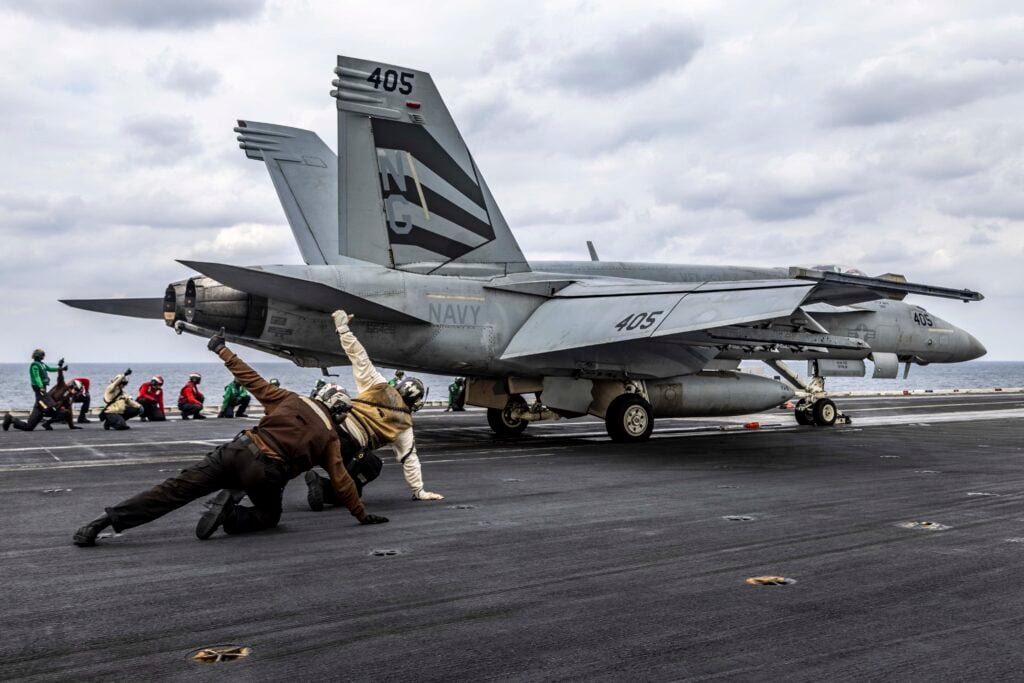
F/A-18E aircraft on the aircraft carrier “Abraham Lincoln” | Photo: US Army Central Command X-Account
In a subsequent conversation with ABC, Trump backed the strikes: I think it’s very important to respond. They shot down a helicopter, and we are responding as we speak.” In Congress, the move won broad Republican support. House member Scott Perry told reporters: “We’re not going to allow a rogue terror regime to shoot down one of our aircraft without consequences. Nobody wants to be in a war, but they’re the ones who declared war on the United States. The president wants to end this war, and I support him in that.”
Meanwhile, dramatic details were cleared for publication about the pilot rescue operation, which a Pentagon official described as a medical miracle. The two crew members of the Apache helicopter, belonging to the aviation brigade of the 82nd Airborne Division, were forced to remain in the water for two hours in complete darkness, in a low maritime patrol area exposed to attacks. Because Apache helicopters are not equipped with ejection seats, the two escaped from the damaged aircraft when it hit the water.
They were rescued by a 24-foot unmanned autonomous vessel called a Corsair, capable of traveling over 1,150 miles and carrying a 1,000-pound payload. The autonomous boat, operated remotely, belongs to Task Force 59—the first operational unit in U.S. Navy history based entirely on artificial intelligence, established in 2021 by Admiral Brad Cooper. The Corsair boats are brand-new hardware deployed to the Middle East only in late March, and this is the first time they’ve been used for real-time human rescue under fire. Captain Tim Hawkins, Central Command spokesman, confirmed: “We practiced this scenario in drills, but not necessarily in this way.”
Meanwhile, the Gulf theater erupted with panicked Iranian counter-responses. Iran’s Revolutionary Guards published an official statement on their Telegram channels claiming they fired long-range solid-fuel missiles and drones at American bases, including Fifth Fleet headquarters in Bahrain. The escalation forced Bahraini authorities to issue an urgent warning to civilians on social media: “Proceed immediately to the nearest safe location.” Simultaneously, Kuwait’s military officially announced on its accounts that its air defense systems were activated and actively intercepting hostile fire that penetrated the area.
The Revolutionary Guards statement read in part: “4 key targets at the air base and command and control center of the child-killing American army in Al-Azraq, Jordan, were targeted. In the name of Allah, crusher of the arrogant… the brave aerospace fighters of the Revolutionary Guards, using their long-range solid-fuel missiles, destroyed 4 important targets, including the hangars of F-35 fighter jets.”
Iranian Foreign Minister Seyed Abbas Araghchi joined the desperation, writing on X: “Despite its defeats on the battlefield, the U.S. chose to test our resolve. Our powerful armed forces will not leave any attack or threat unanswered. Leave our region if you want to be safe. The history of the Persian Gulf has many chapters about the bitter fate of foreign invaders. Foreign forces near our territory are in constant danger due to their human errors, simple accidents, or the possibility of being caught in crossfire.”
Following the attacks and fears of disruptions to global energy supplies through the region’s straits, sharp price increases were recorded in the markets. Brent crude jumped 83 cents (0.9%) to $92.29 per barrel, and U.S. oil rose 68 cents (0.8%) to $88.97 per barrel, an increase also supported by Reuters reports indicating a sharp drop in U.S. crude oil inventories.
The Apache downing is the latest in a chain of severe aviation losses suffered by the American deployment in the region. According to a May report by the Congressional Research Service, the U.S. has lost or sustained heavy damage to 42 aircraft since the conflict erupted, including numerous MQ-9 Reaper drones shot down by Iranian air defense systems, including another drone downing over Jom province mentioned in the current Iranian report.
Analysis of Pentagon data reveals the severity of damage to manned aircraft throughout the fighting months: F-15E aircraft losses and friendly fire: The U.S. lost four advanced F-15E Strike Eagle fighter jets in the campaign. Of these, three aircraft were shot down as a result of a critical friendly fire error by our forces in Kuwaiti skies. The fourth aircraft was shot down inside Iranian territory. During a complex rescue operation conducted deep inside Iranian territory to retrieve the two pilots of the fourth F-15E, an American A-10 Thunderbolt II attack aircraft also crashed.
In March, a deadly mid-air collision occurred between two KC-135 refueling aircraft over Iraq, leading to the deaths of six crew members. Additionally, several other refueling aircraft and a single central command and warning aircraft, an E-3 Sentry, sustained significant damage while parked on the ground following missile and drone attacks on a military base in Saudi Arabia.
In his conversation with the Wall Street Journal, Trump emphasized that the American naval blockade is achieving its goal and making the Iranian regime “very poor,” and made clear he intends to keep the siege in place as long as necessary. However, the vulnerabilities of the American air deployment in the Strait of Hormuz area—a narrow maritime passage where Apache helicopters are forced to fly at low altitude to escort merchant ships and destroy Iranian fast boats, as they successfully did in May—expose Western forces to constant attrition.
Parallel to the direct exchanges between the U.S. military and the Iranian military, the regional campaign expanded this week when the Israeli Air Force also conducted targeted strikes inside the Islamic Republic. The Israeli strikes focused on hitting production infrastructure and launch sites for drones and ballistic missiles, aiming to disrupt the supply chain of these systems to various combat theaters across the Middle East.