


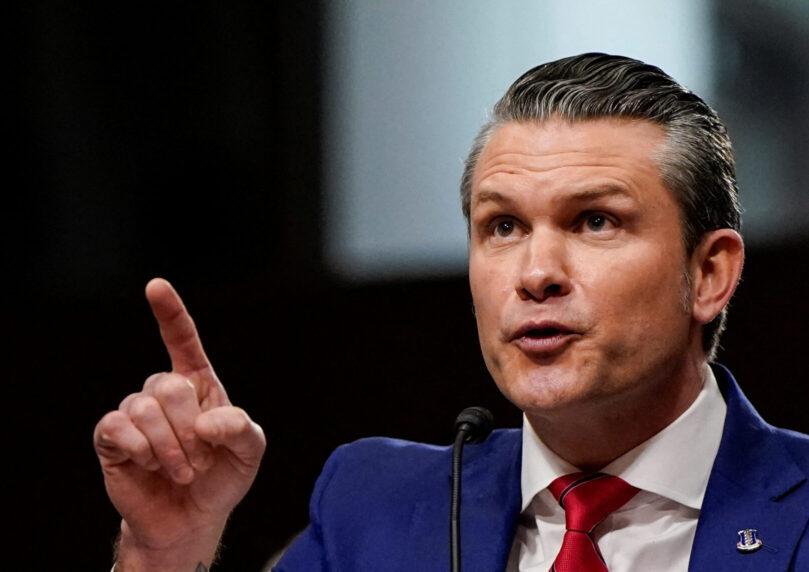

In recent months, a series of shakeups has rocked the top ranks of the U.S. military, culminating in April with the immediate firing of Army Chief of Staff General Randy George. Just one day before his dismissal, George requested a personal meeting with Secretary of War Pete Hegseth to discuss technological coordination and ease tensions, but the meeting never took place. He was notified of his termination by phone, and the announcement was posted on social media. A CNN investigation published today (Tuesday) lays out the new policy under Hegseth.
Hegseth’s management strategy is characterized by extensive centralization of authority within his office and tight control over information flow. During planning for logistical and strategic moves involving Iran—including preparations related to major military deployments in the Middle East—the information was kept within a narrow circle, with some members of joint staffs briefed at relatively late stages. The goal of this compartmentalized approach is to maintain operational discipline and reduce the risk of sensitive information leaking to the media.
As part of an uncompromising effort to combat leaks, the War Department has expanded the use of periodic polygraph tests and required personnel involved in special operations to sign non-disclosure agreements. Following media reports that contradicted Pentagon assessments of damage to Tehran’s missile capabilities, Hegseth ordered U.S. Central Command to conduct rigorous internal reviews and warned troops against sharing even unclassified information on social media.
Beyond operational changes, Hegseth’s compartmentalization measures and sweeping command overhaul also severed one of the War Department’s most sensitive political back channels. The CNN investigation revealed that Army Secretary Dan Driscoll maintained a close personal relationship with Vice President J.D. Vance—his Yale Law School classmate—and used that connection to advance Army priorities directly with the White House, bypassing the Secretary of War’s office.
Hegseth, who viewed this direct line as a challenge to his authority, responded by tightening reporting structures and centralizing communications through his office. He imposed a rigid hierarchy requiring senior officials to report through established channels and placed trusted allies in key positions on joint staffs. In doing so, Hegseth cut off the Army leadership’s independent access to Vance and reinforced centralized oversight across the military chain of command.
Pentagon spokesman Sean Parnell rejected media criticism of these moves, saying: “The anonymous sources being quoted are outsiders with a clear political agenda to smear the department and undermine Secretary of War Hegseth’s leadership through partisan hit pieces. Every successful organization undergoes leadership changes, and we thank those who have departed for their service. Decisive steps have been taken to align military leadership with the priorities of the President, the Secretary, and our warfighters.”
Alongside the leadership changes, Hegseth also dealt with political complexity involving Army Secretary Dan Driscoll’s relationship with Vice President J.D. Vance. Hegseth’s office sought to ensure that all coordination and communication with the White House flowed through official War Department channels. As part of his broader effort to reshape military leadership, Hegseth appointed his senior military aide, General Chris Laney, to the position of Vice Chief of Staff months earlier. Laney now serves as acting Army Chief of Staff, replacing the ousted General George.
The appointment of Pete Hegseth—a Fox News host and decorated former officer—as Secretary of War reflected the administration’s stated goal of implementing deep structural reforms within the War Department. The administration sought to replace senior officers perceived as promoting progressive worldviews and refocus the military on operational readiness and combat preparedness. During a congressional hearing, Hegseth explained the rationale behind the dismissals: “It’s very difficult to change the culture of a department that has been damaged by wrong perspectives, using the same officers who were there.”
Hegseth’s moves represent a sharp break from the War Department’s longstanding tradition, in which professional military leadership maintains stability and continuity regardless of political changes in Washington. Removing senior officers and appointing officials aligned with the administration’s priorities—such as General Laney and Hong Cao—is intended to create a more streamlined command structure capable of implementing leadership directives quickly and with minimal internal resistance.
Although the policy has raised concerns among some members of the House Armed Services Committee, who argue that increased compartmentalization and significant personnel turnover amid heightened tensions with Iran could create instability, Hegseth’s standing within the White House remains strong. President Donald Trump continues to back him publicly, praising his direct communication style and describing him as a “wartime secretary” who is carrying out the mandate he was given to reshape the United States military.