


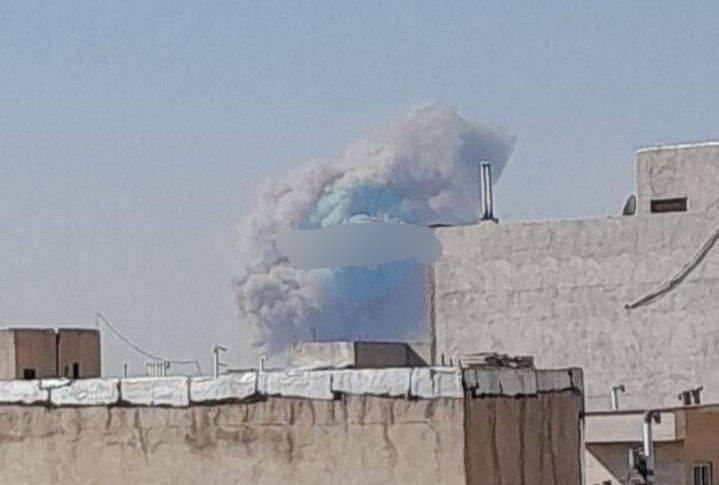

A series of official details released today (Monday) reveals the precise scope of the combined missile attack Israel absorbed from Iran and Yemen, alongside the results of two intense strike waves the Air Force carried out deep in terror territory. The picture that emerges is one of a carefully planned and timed campaign. Israel made clear this morning that the country is facing days of battle and sustained combat, and presented evidence of the collapse of Tehran’s defense systems. Meanwhile, US President Donald Trump posted on Truth Social that “Israel and Iran should stop firing immediately.”
The dual-front threat map that operated simultaneously against Israel includes Iran and the Houthis. Israelis experienced multiple barrages in the past 24 hours: a total of 22 missiles were detected and fired from Iranian territory toward Israeli civilians. The Houthi proxy operating under Tehran’s terror sponsorship fired two missiles at Israeli civilians. Air defense systems intercepted one missile, and the second fell during flight before crossing into Israeli territory.
Against the backdrop of denials from Tehran’s spokesmen, the IDF reveals that the Israeli Air Force operated alone in Middle Eastern skies without an active coalition during the bombing phase: “Only we attacked. That said, we are operating with the Chief of Staff and senior military officials fully coordinated with the Americans—both on the offensive and defensive fronts.”
The military operation deep inside Iran, commanded by Chief of Staff Eyal Zamir and senior Air Force officials from “the Pit” at the Kirya, was divided in a planned manner into two separate and intense strike waves, designed first to neutralize the regime’s response capability and then to hit strategic assets:
The first strike wave carried out overnight focused on achieving absolute air superiority in the country’s skies. Fighter jets fired precise long-range munitions and destroyed in a targeted manner nine Iranian air defense systems in the west and center of the country, a move that opened a free and safe flight corridor for the continuation of the operation.
After neutralizing the detection and interception systems, the second wave was launched, aimed at the regime’s terror infrastructure and economic targets. In this wave, the petrochemical plant in Mahshahr in southwestern Iran was attacked and bombed, with the Air Force recording precise hits that destroyed three central buildings inside the plant complex.
The military makes clear that the mutual blows are not a one-time event that ended with the fighter jets landing at their bases, and the army is preparing in an elevated manner for several days of continuous combat against Iran and its proxies in the region.
Behind the scenes of the operational activity, the defense establishment explains that the attacks in Iran are a direct continuation of Operation Roaring Lion and not the beginning of a new campaign. Comprehensive headquarters work and a range of operational options that were examined in advance allowed for a high level of alert that has been maintained since the beginning of April, and the scenario that materialized tonight was one of the prepared scenarios.
The IDF estimates that while Tehran is trying to present its actions as defending its proxies, in reality, it is the one who violated the ceasefire that lasted about two months by firing directly at Israel. Now, the main target that has been marked is serious damage to the Iranian regime and its capabilities while trying to create a distinction between the arenas, while the army already has follow-up plans and additional target banks.
On the international level, full coordination with the United States and the American Central Command is closer than was announced: the Chief of Staff has spoken with the CENTCOM commander three times since yesterday (Sunday), and American military officials were not surprised by the activity carried out on the ground, with the United States assisting exclusively in the defensive effort, but the attacks themselves are solely Israeli.