


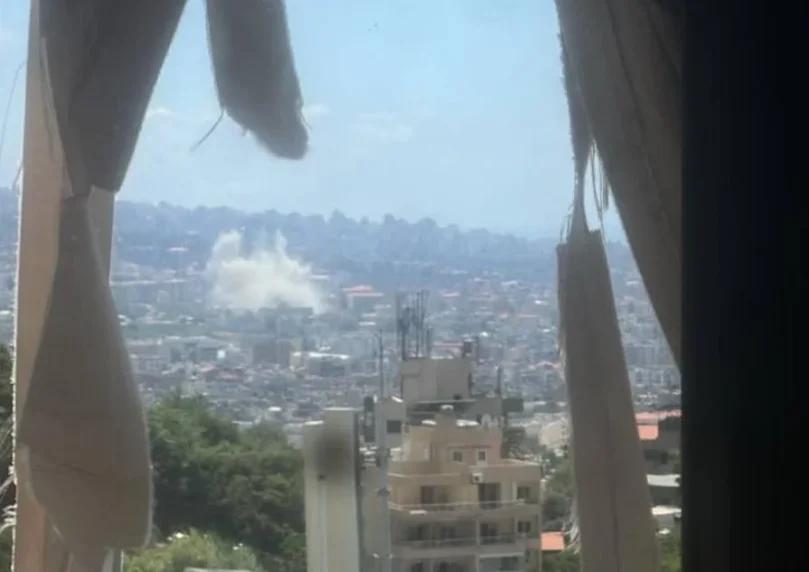

Israeli forces launched a wave of targeted attacks in the Dahieh area today (Thursday), with the Air Force’s main target being Ali al-Hisani, the head of the missile and launch systems portfolio in the pro-Iranian Imam Hussein Division. The targeted attack on the heart of the terrorist stronghold in the Lebanese capital was carried out following continuous intelligence surveillance, and marks another direct hit on the top command of the multinational militias that Iran operates in the northern arena. Reports in Lebanon indicate that loud explosions were heard and thick smoke was seen rising from the building that was attacked, while the security forces in the country are examining the results of the targeted assassination.
The offensive activity of our forces in the Dahieh area focused on the building where Ali al-Hisani, a key figure in the buildup and exercise of power of the Axis of Evil in Lebanon, was staying. In his role as the head of missiles in the Imam Hussein Division, al-Hisani managed and directed the array of rockets, artillery, and operational infrastructure used by militia operatives to conduct direct fire at Israeli communities and IDF bases.
The Imam Hussein Division, originally established by former Quds Force commander Qassem Soleimani, is composed of thousands of Shiite fighters and operatives of various nationalities from across the Middle East. In recent years, and especially during recent rounds of fighting, the organization has shifted its operational center of gravity from Syria to Lebanese territory, where it operates in full coordination and subject to Hezbollah’s operational plans. The attack on al-Hisani, who leads the division’s missile portfolio, is a severe professional blow to the militia’s launching and coordination capabilities in the arena.
The targeted attack in Beirut against the head of the division’s missiles Imam Hussein emphasizes our forces’ strategy to strike not only Hezbollah’s command echelon, but all the branches and branches that Iran is trying to develop on Lebanese soil. The Imam Hussein Division has suffered severe blows in recent times, including the assassination of the force’s commander, Ali Maslam Tabaja, and other senior figures last March, and the current attack proves that the security establishment continues to persecute the new command echelon that is trying to rehabilitate the ranks of the organization.
The operational significance of hitting Ali al-Hisani is a direct disruption of the chain of command and control in the militia’s rocket array. Hitting the professional responsible for planning, supplying, and executing missile attacks creates an immediate command vacuum, harms the morale of the operatives, and slows down the pace of production and armament. At this stage, the Israeli security establishment is casting doubt on the success of the attack, our military affairs correspondent Hallel Bitton-Rosen reported. Now, attention is Referring to official intelligence reports from the field in Lebanon, which will confirm whether al-Hissani was indeed eliminated in the hideout apartment in the Hadahiya district.
Last night, our political correspondent Moti Kastel published a series of quotes from the cabinet meeting, in which the various ministers attacked Israel’s helplessness against Hezbollah. Energy Minister Eli Cohen attacked Israeli restraint and said: “It’s strange that we have to be on guard when they are harming us during the ceasefire – they are violating it and we have to be on guard? It is our right to act!”. Continuing the discussion, Minister Cohen added that in his opinion there is no choice but to expand the targets: “There is no choice but to also hit the Lebanese government so that they will pay a price. They are a country and are responsible and their infrastructure must be damaged.”
Transportation Minister Miri Regev raised the question of the neighboring country’s responsibility and wondered: “What is Lebanon doing against Hezbollah?”. National Security Minister Itamar Ben Gvir replied dismissively: “They are doing nothing! They have two ministers from Hezbollah.”
The ministers then began discussing ways to create an effective deterrent against Lebanon. The Minister of Settlement and National Missions, Orit Strook, noted that “we need to look for what hurts them.” Defense Minister Israel Katz stated his position and said that “it hurts them that their territory is being taken away.”
Minister Ben Gvir demanded that the model of action from the Gaza Strip be copied to the Lebanese capital: “It will hurt them if we flatten the Dahieh! We will do what we did in Rafah there, we will move the population. I understand that there are those who will not like it, but an attack on our soldiers and civilians is a red line.” Agriculture Minister Avi Dichter said that “we need to see if the steps the IDF is proposing are sufficient.”

Earlier today, the IDF permitted publication that Sergeant Rotem Yanai, 20, from Givat Ada, was killed during an operational activity in the north of the country as a result of an explosive drone strike. Rotem, who served as a noncommissioned officer in the Rotem Battalion of the Givati Brigade, was promoted after her death from the rank of corporal to the rank of sergeant. In that incident, two reservists were seriously and moderately injured, and following it, our forces began attacks on the city of Tyre.