


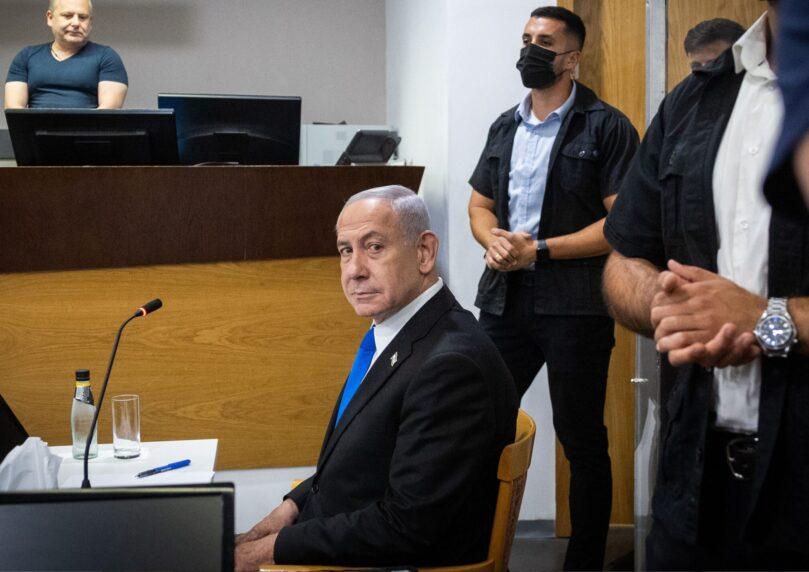

The evidentiary phase of Prime Minister Benjamin Netanyahu’s trial hit a breaking point Sunday in Jerusalem District Court, when retired police investigator Oded Ben Moshe was forced to admit his unit conducted sensitive surveillance on thousands of files without obtaining court warrants—and in a manner that completely exceeded the timeframe outlined in the indictment.
The cross-examination, led by defense attorney Amit Hadad, focused on exposing investigative procedures carried out on the Prime Minister’s Office security system that violated the immunity of elected officials and ignored digital evidence in police possession. Ben Moshe, called to testify by the defense after prosecutors dropped him as a witness, found himself confronted with a series of classified memos and operational reports from August 2017 proving police conducted sweeping data collection with no time restrictions.
The courtroom quickly reached high tension when Hadad presented a police operational report from August 24, 2017, documenting the extraction of entry and exit data from Prime Minister’s Office computers without a warrant. This prompted direct intervention from Judge Baram, who sought to understand the status of the operation: “Was this pursuant to a court order?” The witness responded: “There was no court order here.”

Hadad then pressed him: “You acted without a warrant and didn’t limit this to specific dates or time periods, correct?” Ben Moshe confirmed: “According to the report, yes.” When Hadad pushed further—”There was no shortage of failures in the investigation, but to conduct this operation without a warrant, how does something like this happen without a warrant?”—the retired investigator replied: “I said… I know you don’t go to a bank without a warrant, there are cases where it’s clear you need a warrant. I’m speaking from my experience, I’m not a lawyer. From my experience I’ve dealt hundreds of times with witnesses and documents without a warrant.”
Hadad displayed on courtroom screens that police tracked meetings of senior politicians like Ze’ev Elkin and Ilan Kabel in 2016 and 2017—periods unrelated to the indictment in Case 2000, which ended entirely in early 2015—and demanded the investigator explain the improper investigation.
Hadad confronted Ben Moshe: “If you didn’t think there was a problem—a meeting of two senior politicians without a warrant, a period not relevant to any investigation, ’16-’17 aren’t relevant, not to Case 1000 and not to Case 2000… Case 2000 ended in early ’15. Explain to me, why did you check Elkin’s presence in ’16-’17? Do you check if one politician met with another?”
The witness responded: “Probably a mistake.” Judge Baram tried to clarify the work dynamic and asked: “Do you decide on relevance or is this guidance you receive? Or to check what’s possible? What’s the dynamic of how this works?” Ben Moshe replied: “It’s hard for me to remember about the times… I don’t recall a discussion about immunity. Regarding time limitations, I have no answer for that. I don’t know if it was my personal mistake or we didn’t pay attention to it.”
The central fault line in the testimony was exposed when Ben Moshe was forced to admit the unit possessed investigative reports and objective data from investigator Idan Aviram that directly contradicted the quantities and frequencies of champagne and cigars described by key witness Hadas Klein—but police chose to bury these findings and never present them to any witness in the case.
Hadad asked him: “How is it possible that on a marginal, side issue like her trip abroad on December 14 or the safe, you went and checked Hadas Klein’s version, but on the heart of the matter… Idan Aviram agreed this report contradicts Hadas Klein’s supply thesis, was he aware of this?” Ben Moshe replied: “No.” Hadad continued: “He didn’t tell you this?” The witness repeated: “No… they didn’t raise the issue with me, you didn’t know about the contradiction.”
Moreover, Ben Moshe openly confirmed he hadn’t read Klein’s statements at all before determining she was credible. When asked: “How did you know she was good and reliable? From your impression, she seemed reliable? Because of her hair color or eyes?” he responded: “No. Because she was a central witness… Danny was a parallel commander to me, also a friend. He questioned her several times. I understood the dynamic there was good, they need something and turn to her.”
The defense attorney moved to address documentation procedures and confronted the witness about the practice of team leader Momi Mashulam, who allegedly systematically avoided documenting substantive calls and meetings in official reports—as happened in the phone call he conducted with Arnon Milchan in which the issue of “reciprocity” between him and the prime minister came up.

Hadad asked him as a former senior officer: “Did you know that Mashulam didn’t document the version Milchan spoke with him when he talked to him on the phone and told him about reciprocity between him and the PM—he didn’t document this in an acquaintance report?” The witness replied: “No.” Hadad continued pressing: “According to the rules you know, as a commander, is there an obligation to document something like this in files? It’s relevant to the suspect’s defense. Is there an obligation to document this in a report?” Ben Moshe completely confirmed the defense position: “You document almost everything, according to relevance. This is important… to my understanding, yes.”
The retired investigator admitted he recently spoke by phone with his former commander Momi Mashulam just days after the defense sent him the official court summons—something that raised objections from the defense attorneys. Hadad asked him: “You said here, to this day you’re in close contact with Mashulam, you meet with him, talk to him?” Ben Moshe replied: “We haven’t met in a long time. We spoke recently a few days ago.” Hadad pressed: “After you were summoned, I assume,” and the witness admitted: “Yes… he called me… he heard I was summoned and that’s it. We didn’t talk about the testimony, we talked about completely different things.”
Ben Moshe’s testimony sheds new light on what happened behind the scenes during the completion phase of the investigation into the prime minister’s cases in 2018, a period when he became the central liaison for the investigative unit with tax and economic prosecutors to carry out specific tasks like extracting entry and exit data from the country and seizing materials.
The revelation that prosecutors summoned Ben Moshe in recent weeks to 2-3 refresher sessions in Tel Aviv, where he sat alone in a room reading open binders, and ultimately chose to drop him as a prosecution witness, indicates the prosecution’s clear fear of exposing these failures in court.
The implications are a fatal blow to the evidentiary solidity of Case 1000 and bolster the “denial of justice” defense claim, since a senior police officer’s admission that the unit conducted invasive searches on politicians without warrants, while deliberately ignoring objective evidence contradicting the key witness, strengthens the defense thesis that the case was conducted as a targeted “fishing expedition” marked from the start.