


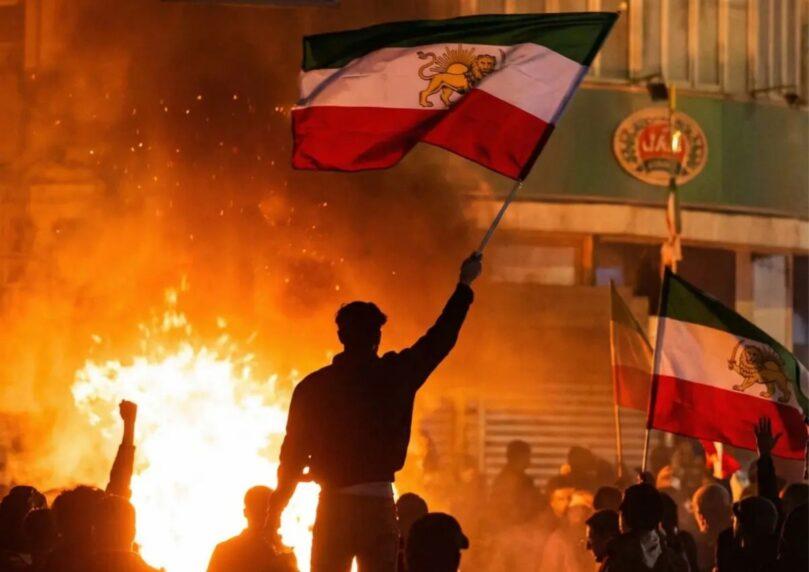

The Trump administration is examining a shift toward armed support for Iran’s internal opposition while maintaining a full blockade of the country’s ports. Administration statements about destroying the regime’s missile capabilities are overly optimistic, Fox News reported Friday. Meanwhile, classified intelligence assessments point to military and economic resilience far higher than expected. Direct confrontation on the ground has escalated into heavy exchanges that included attacks on American bases and targeted assassinations of senior Revolutionary Guard commanders, according to the Washington Post.
A day after the U.S. military carried out extensive strikes in Iran in response to attacks on American warships, President Trump is advancing the idea of arming Iranian civilians. The discussion of arming the Iranian opposition has shifted from taboo to potential working plan in the U.S. following President Donald Trump’s remarks in an interview on “The Hugh Hewitt Show”: “They have to have guns. And I think they’re getting some guns. Once they have guns, they’ll fight as well as anybody over there.”
Senator Lindsey Graham added in an interview on “Hannity”: “If I were President Trump and I were Israel, I would load up the Iranian people with weapons so they can take to the streets armed and turn the tide in the battle inside Iran.”
On the military front, CIA data paints a different picture from administration statements about destroying Iran’s missile capabilities. According to the classified analysis: Iran retains 75% of the mobile launcher systems it had before the war, and the regime holds 70% of its original missile inventory.
These figures contradict President Trump’s words last Wednesday: “Their missiles have been mostly destroyed, they probably have 18, 19 percent left, but not much compared to what they had,” according to the Washington Post.
The blockade is costing Iran roughly half a billion dollars a day, but a CIA report notes the regime can survive economically for at least another 90 to 120 days. Tehran is storing oil on anchored tankers to overcome the blockade. American intelligence estimates Iran will be able to hold out 3 to 4 months before facing truly severe economic difficulties, the Washington Post reported.
Following the collapse of peace talks in Pakistan, Trump imposed a full blockade on all ships entering or leaving Iranian ports. On Sunday, Trump announced “Project Freedom” to escort commercial vessels through the Strait of Hormuz. On Tuesday, operations were suddenly halted. The president explained the operation was suspended following “major progress” in peace talks and at Pakistan’s request.
Last night, the Middle East shook following direct and severe exchanges of fire between U.S. military forces and the Iranian military in the Strait of Hormuz area. The military blow, which constituted the most serious incident since a ceasefire was declared about a month ago, occurred while Washington awaits an official response from Tehran to a comprehensive peace proposal.
Despite reports of airstrikes on Iranian territory and the destruction of vessels, President Donald Trump insisted the ceasefire is still in effect, while combining contempt for Iran’s operational capabilities with unprecedented threats about the country’s future if negotiations fail.
The incidents began when three American destroyers attempted to pass through the Strait of Hormuz as part of the American effort to break the Iranian naval blockade. According to U.S. Central Command, Iranian forces attacked the ships using missiles, drones, and fast boats. The American destroyers returned deadly fire and destroyed the sources of fire.
President Trump posted a tweet on the subject and sent a threat to the Iranian regime: “Three world-class American destroyers just successfully crossed the Strait of Hormuz, under fire. They sustained no damage, but great damage was done to the Iranian attackers. They were completely destroyed along with many small boats. The missiles fired at us were easily shot down, and the drones came and burned while still in the air. They fell beautifully into the ocean, just like a butterfly falling to its grave!”
Trump added that Iran “messed with us” and that the American response was “just a touch of love,” an expression meant to illustrate that the U.S. used only a small portion of its power. “A normal country would have allowed these destroyers to pass, but Iran is run by lunatics,” the president added.
From the other side, Tehran presented a picture of violated sovereignty. The Iranian military command accused the U.S. of attacking an Iranian oil tanker and carrying out aerial bombardments on civilian areas on Qeshm Island and in the cities of Bandar Khamir and Sirik. An Iranian military spokesman declared: “The U.S. and its allies must know that Iran will respond forcefully and without hesitation to any act of aggression. Our attacks inflicted significant damage.”
Despite the bellicose statements, official Iranian media reported hours later that “the situation has returned to normal” in cities along the coast. Meanwhile, despite recent events, Trump claims diplomatic negotiations continue and that Iran has already agreed in principle to the U.S.’s key condition: complete renunciation of nuclear capability. Trump revealed that the American proposal is a comprehensive and detailed document.