


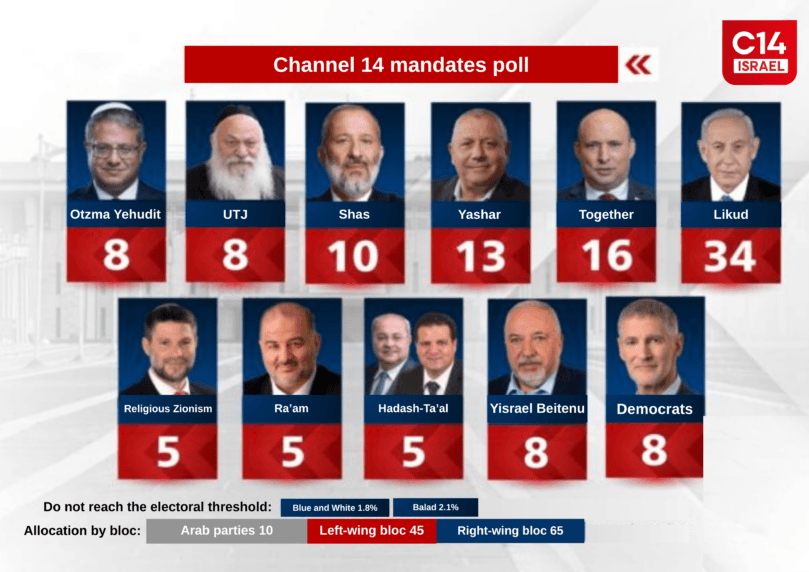

A Channel 14 poll released tonight shows Netanyahu’s right-wing bloc maintaining stability with 65 seats—a solid majority that would allow Benjamin Netanyahu to form a government. The survey also reveals a dramatic fall in support for the Bennett-Lapid merger.
The poll, conducted today (Thursday) by NEXT DATA among 721 participants from across the population, exposes dramatic data—chief among them proof of fading hype around the Bennett-Lapid union. The survey shows the right-wing bloc holding its strength at 65 seats, a stable majority enabling the formation of a government led by Benjamin Netanyahu, who leads by a massive margin over all rivals in suitability for prime minister.
According to the seat breakdown, Likud under Netanyahu is Israel’s largest party with 34 seats. Behind it, the ‘Together’ party gets 16 seats—no less than 4 seats below the 20 it received in the first poll after the merger. Eisenkot’s ‘Yashar’ jumps to 13 seats—one seat more than the previous poll. The ultra-Orthodox parties maintain their strength with 10 seats for Shas and 8 for United Torah Judaism. Otzma Yehudit [Jewish Power] gets 8 seats, as do the Democrats and Yisrael Beiteinu. Religious Zionism gets 5 seats.
In the left-center bloc, the picture is far more troubling for them, with the entire bloc standing at just 45 seats. The Arab parties, Hadash-Ta’al and Ra’am, each get 5 seats and don’t constitute an influential factor in coalition formation. Below the electoral threshold are the Balad party (2.1%) and Benny Gantz’s party, Blue and White, which gets just 1.8% of the vote.
Now for the suitability question for prime minister. Prime Minister Benjamin Netanyahu wins sweeping support from 56% of the public, opening a massive gap over all his competitors. In second place, at a significant distance, is Gadi Eisenkot with just 20%. Former Prime Minister Naftali Bennett gets 18%, Avigdor Lieberman 5%, while Benny Gantz wins the confidence of just 1% of the public.
The poll was conducted today (Thursday), May 7, 2026, by NEXT DATA among a representative sample of 721 adults from across Israel’s population. Data analysis was performed by strategic commentator Shlomo Filber.