


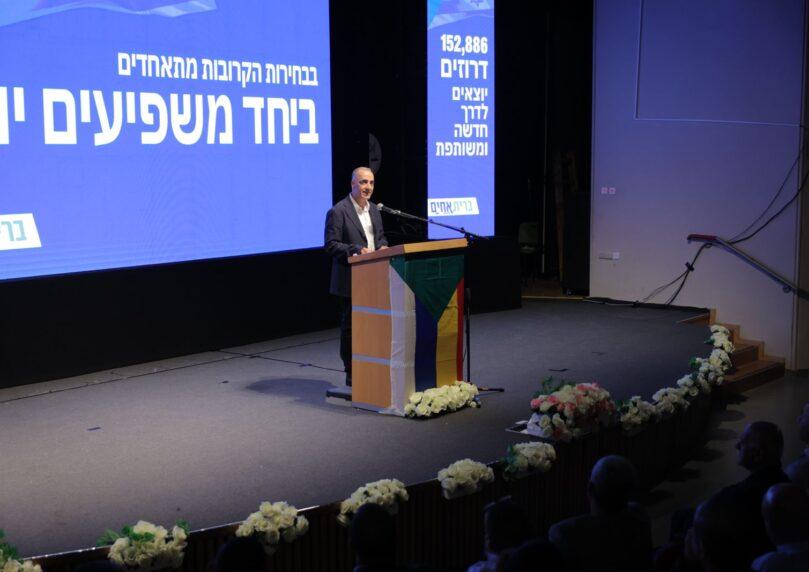

Less than six months remain until Israel’s elections, and the political system is heating up with new initiatives hoping to catch a ride on the political wagon and become the race’s surprise. One of the most interesting initiatives launched Monday in the village of Maghar: “Covenant of Brothers”—a new political framework aiming to unite the voice of Israel’s Druze community under one roof, led by Col. (res.) Wajdi Sarhan.
For many decades, the partnership between Israel’s Druze community and the state has been expressed through very high enlistment rates in the Israel Defense Forces (IDF) and significant presence in the most combat-intensive units. But traditionally, this partnership hasn’t translated into adequate political representation. Until now, Druze representation in the Knesset has come mainly through reserved slots in general parties—in Likud, centrist parties, Labor, and the National Unity party—without the community operating as a unified, independent political body.
Significant change began bubbling in recent years, driven by implementation of the Kaminitz Law, which included heavy fines for building violations in Druze villages, and approval of the Nation-State Law, which sparked deep emotional and public turmoil among community members. These events created a strong desire among broad segments to try translating their power into direct political influence, with a stated intention to change the laws from the root and take their fate into their own hands, rather than relying on the goodwill of the major parties.
Demographically, Israel’s Druze population has recorded impressive growth since the state’s founding. In 1949, the community numbered only about 14,500 people, while today it counts over 154,000 residents living mainly in the Galilee and Carmel regions.
The central villages that form the core of electoral power are Daliyat al-Karmel with about 18,000 residents and Yarka with about 16,000 residents. Alongside them live about 30,000 Druze in the Golan Heights, many of whom don’t hold Israeli citizenship and therefore lack voting rights in national elections.
The new political framework launched in Maghar also presents a surprising and refreshing element relative to sectoral political tradition: the inclusion of Druze women in key leadership positions in the party. The party aims to maximize its power through modernization and representation of all population segments, while maintaining the community’s values. But everyone understands that facing the electoral threshold requires more than 150,000 votes, a completely independent run seems nearly impossible without creating broader connections.
The coming months will be decisive for Wajdi Sarhan and his colleagues, and will determine whether this initiative succeeds in becoming part of a new and surprising political house that changes the face of Israel’s parliamentary map. The big question that remains open is whether “Covenant of Brothers” will succeed in breaking through the glass ceiling and influencing from within, or whether it will end its path as yet another of the dozens of parties that tried their luck in recent years and remained outside the Knesset.