


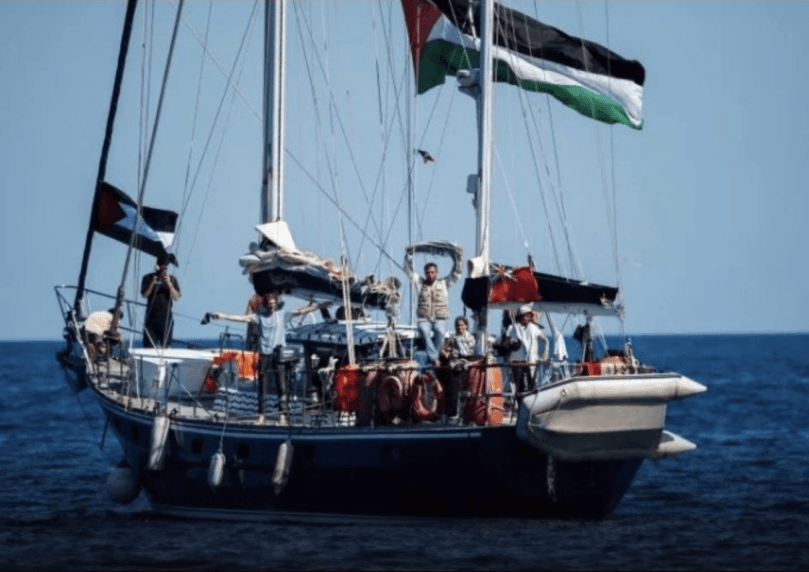

Another night, another headline. Early this morning, more vessels were seized near Greece, part of preparations for this wave of the “Sumud Flotilla.” The incident demonstrates once again that global hate organizations have internalized that applying maritime pressure costs them nothing in practice. The organizers continue operating in classic “rinse and repeat” fashion: they manage to stir up commotion, absorb a delay, and earn international airtime. Facing a maritime threat designed “to bring Israel to its knees,” a revolution in operational doctrine is required—replacing the language of containment with painful, crushing economic language.
Analyzing the incentive structure reveals a grim picture of current policy. Until now, the Israeli government, through its legal officials, has pursued a defeatist policy of “catch and release.” Activists are intercepted, brought to port, and immediately put on flights back to their countries of origin, sometimes at taxpayer expense. The ships themselves rust and in most cases are returned afterward to their owners through exhausting bureaucratic procedures. The organizers view such activity as an excellent marketing investment: they buy vessels for millions of dollars and get billions in propaganda. Economist Milton Friedman taught us there is no action without cost, but today, the international activists aren’t paying that cost. We’re paying it in reputation and ongoing security.
I want to present the alternative. International maritime law provides a clear answer to the problem—an answer that Attorney General Gali Baharav-Miara refuses to adopt. When a legal naval blockade is imposed on Gaza, any vessel attempting to break it is defined as a legitimate target for seizure as “maritime prize.” The solution is simple and brutal: advance declaration that any vessel found attempting to break through will be confiscated immediately. Upon seizure, the ship is towed to Ashdod port, becomes state property through expedited civil forfeiture proceedings, and is offered for public auction.
The question “compared to what?” sharpens the advantage. Compared to apologetic public diplomacy and international legal battles, a confiscation move strikes directly at the economic artery of the provocation. The funds collected from the public sale won’t go to the general treasury but to a dedicated fund for compensating terror victims in the Gaza border area or rehabilitating wounded IDF soldiers. The moment an anti-Israel organization understands that purchasing a ship in Spain or Italy is effectively a direct cash donation to Kibbutz Be’eri or Golani reconnaissance fighters, its motivation to organize a flotilla will plummet to absolute zero.
The government’s duty, from Prime Minister Benjamin Netanyahu through Finance Minister Bezalel Smotrich and Justice Minister Yariv Levin, is to demand implementation of a tough policy and ignore the bureaucratic fear of “disproportionality.” A maritime flotilla seeking to isolate the state is an act of economic and sovereign terrorism requiring swift crushing. Only extracting a dramatic and final economic price, through uncompromising confiscation, will eliminate the provocation mechanism and restore Israel’s control over the maritime space.