


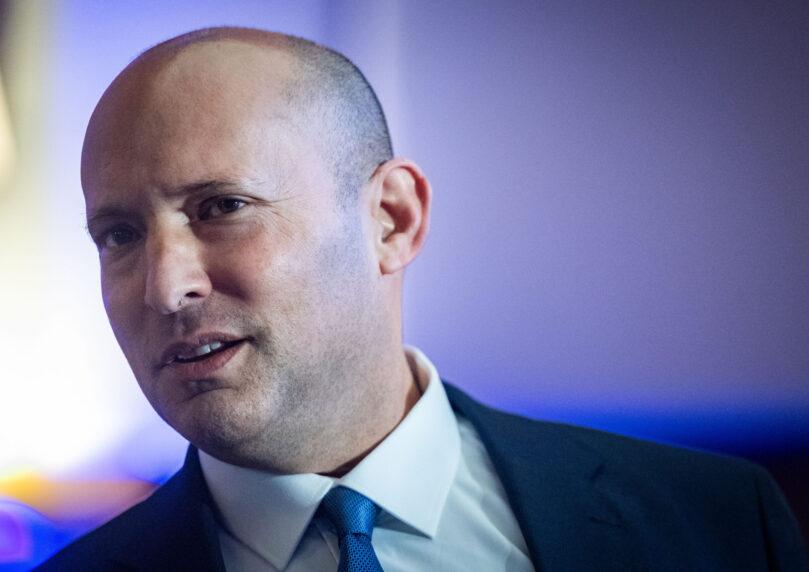

To his credit, Naftali Bennett came prepared. In yesterday’s round of interviews across nearly every channel, there was hardly a question he didn’t have a ready answer for. It was clear the former prime minister invested considerable time with his advisers to carefully plan the orchestrated media blitz, ran simulations, and knew how to pull out the right response to questions in real time. One thing Bennett struggled to hide: the panic. The fact that after a dramatic political move—presented by him and his new-old partner Yair Lapid—the first polls were a complete failure meant Bennett needed a powerful media push to try to fix at least this weekend’s numbers.
Bennett’s big problem is that his entire campaign, from start to finish—from the launch of Bennett 2026 party nearly a year ago to yesterday’s frantic studio sprint—is founded on lies and deception. Throughout this period, Bennett tried to convince voters, mainly on the left, that he’s the only opposition candidate who knows how to bring in voters from the right. That wasn’t true then, and it’s certainly not true today. And the first person who knows this is Bennett himself. If he really knew how to bring votes from the right, he never would have partnered with Yair Lapid. Because what’s better for the opposition camp than a right-wing representative who’ll take the missing mandates needed to form a government without Netanyahu in the next Knesset? The partnership with Lapid is essentially an admission of the lie.
It was important for Bennett to present a false image of someone who knows how to take votes from the right, just to preserve his status as head of the largest party in the camp. This did help him in negotiations with Lapid, who gave up the top spot and even rotation or any appearance of shared leadership. Bennett hoped to be the next “Blue and White”, or the “Zionist Union” of that era—a large bloc that sweeps the entire camp along. It didn’t happen. And it’s not certain it will. This was a question that, despite Bennett being asked about it—sometimes too gently—he had no satisfactory answer to provide.
All the interviews, despite the advance planning or perhaps because of it, were characterized by hollow statements, empty slogans, promises that can’t be kept, or—in cases of complete lack of response—a pre-planned attack on rivals. Bennett knew he’d be asked about his flip-flopping, broken promises, and attempts to undermine his credibility. But the response he planned for these cases was pretty pathetic: an attack on Netanyahu’s credibility. “Netanyahu also said he’d topple Hamas, but he built it up, but you don’t ask about that!” Bennett hurled at one of his interviewers. And he continued with a crude attack on the ultra-Orthodox. Really? It’s well known that in all the studios they only praise and glorify the prime minister and never question things he said or did. What a contrived and forced evasion tactic.
It was easy, beyond the clear talking points, to identify that Bennett fully adopted the terminology common in the opposition. Smotrich is the architect of draft dodging, Ben-Gvir is an extremist. Netanyahu might end up in an orange prison jumpsuit. The Bibi-speak of Kaplan. On the other hand, what’s surprising about that, when the senior adviser he chose to bring on is a senior Kaplanist? The main thing is he knows how to bring votes from the right. Good luck with that.