



After a night of terror in southern Israel, an initial IDF investigation released Sunday morning sheds light on the circumstances of the strikes in Arad and Dimona. The central conclusion from security officials is unequivocal: in both cases, an open miracle prevented heavy loss of life. Despite severe property damage, the fact that the missiles didn’t directly hit occupied residential buildings prevented mass casualties. Still, the IDF isn’t providing answers for the interception failures.
The IDF emphasizes that despite the complex war, the Air Force maintains a 92% success rate in interceptions, while recording over 95% hits on offensive weapons targets inside Iranian territory. The two incidents in the south are defined as a “statistical error” and an unfortunate coincidence, with no professional connection between them.
Investigation findings reveal that in Dimona, the missile landed in an open area that had turned muddy and waterlogged from recent rains. The mud absorbed a significant portion of the blast force and shockwave, substantially reducing the scope of shrapnel and environmental damage.
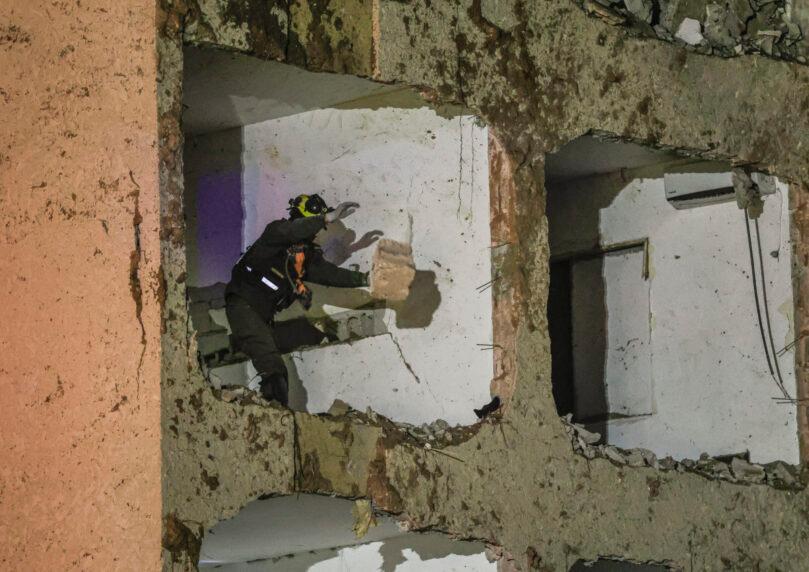
In Arad, the missile fell precisely in the gap between two residential buildings. Though the blast force was enormous, it didn’t cause the structures to collapse directly on their occupants. However, the infrastructure damage is massive: three residential buildings have already been marked and designated for demolition following severe structural damage that cannot be repaired. In both incidents, advance warning was activated in time, and the IDF confidently assesses that all casualties in these events were not in protected spaces during the alert. “Whoever was in a shelter—simply wasn’t hurt,” military sources note.
Abraham Hasson, our reporter in the field, spoke with Saar Shachori, the first ambulance driver to reach the scene in Arad moments after the explosion. His testimony paints a picture of a complex scene filled with chaos: “We heard the explosion at the station and immediately left. When we arrived we saw total destruction and an active fire. Tons of people were running toward us in panic, parents with children in their arms looking for help.”
Shachori emphasizes that despite the difficult sights, it was a miracle: “Most of the injuries that characterized the scene were blast injuries, shrapnel and glass—injuries of those who were exposed. Whoever listened to instructions and entered the safe room came out unharmed. The safe rooms simply proved themselves as lifesavers.” He describes a case of a young child who fell on the stairs on his way to the protected space from the force of the explosion, but miraculously survived and didn’t require significant medical treatment.
As of now, the casualty count in Arad stands at 88 people. Medical teams are fighting for the lives of 10 seriously wounded, including a 4-year-old girl who was extracted in a dramatic operation after being buried under concrete rubble. Additionally, 19 moderately wounded were evacuated from the scene, 55 lightly wounded, and 4 suffering from shock.
Rescue forces in Arad and throughout the Negev remain on high alert. “We’re dispatched to almost every scene at every alert,” Shachori concludes. “The moment we heard the explosion everyone left everything and ran to help. We immediately understood this was an incident of a different magnitude.” The IDF and police repeatedly call on the public: civilian discipline saves lives—remain in protected spaces for 10 minutes from the moment of the alert.